Why Is Medical Transcription Important in Healthcare?

Healthcare depends on accurate information. From patient histories and clinical notes to diagnoses, treatment plans, and follow-up instructions, medical documentation plays a critical role in almost every stage of patient care. This is where medical transcription becomes important. It converts physicians’ and other healthcare professionals’ dictated information into accurate, organized written records that can be reviewed, stored, and shared when needed.
As healthcare organizations handle increasing volumes of patient information, reliable documentation helps improve communication, support clinical decisions, and maintain efficient workflows. Medical transcription therefore remains an important part of healthcare documentation, particularly when accuracy and accessibility are essential.
What Is Medical Transcription?
***[Medical transcription](https://medcore.software/blog/what-is-medical-transcription/)*** is the process of converting recorded or dictated clinical information into written medical documents. Healthcare professionals may dictate information about patient consultations, diagnoses, procedures, medications, medical histories, and treatment plans. A medical transcriptionist or transcription technology then converts this information into a structured format.
The resulting documentation can become part of a patient’s medical record. Depending on the healthcare setting, these records may be used by physicians, nurses, specialists, administrative teams, and other authorized professionals involved in patient care.
Why Is Medical Transcription Important in Healthcare?
1. Supports Accurate Medical Documentation
Accurate documentation is essential for maintaining a complete picture of a patient’s healthcare journey. Transcribed clinical information can help ensure that important details from consultations and procedures are properly recorded.
Well-maintained documentation also makes it easier for healthcare professionals to review previous encounters and understand relevant patient information before making clinical decisions.
2. Improves Communication Among Healthcare Professionals
Patients often receive care from multiple healthcare professionals. Doctors, nurses, specialists, therapists, and other clinical teams may need access to the same information.
Clear medical documentation creates a reliable source of information that can support communication between these professionals. This becomes especially valuable when patients move between departments, facilities, or different stages of treatment.
3. Saves Healthcare Professionals Time
Doctors and other clinicians spend considerable time documenting patient encounters. Medical transcription can reduce the administrative burden associated with turning dictated information into organized records.
Instead of manually typing every detail, healthcare professionals can dictate information while focusing on patient care. Transcription workflows can then transform that information into usable documentation.
4. Helps Maintain Complete Patient Records
A patient's medical history may include consultations, diagnostic findings, procedures, medications, allergies, treatment plans, and follow-up information. Missing or poorly organized documentation can make it more difficult to understand the patient's history.
Consistent transcription helps healthcare organizations maintain comprehensive records that can be accessed by authorized personnel when required.
5. Supports Better Clinical Decision-Making
Healthcare decisions often depend on accurate historical information. Physicians may need to review previous diagnoses, test results, treatment responses, or clinical observations before determining the next step.
Well-documented records provide important context and can help healthcare professionals make informed decisions based on the patient's documented history.
6. Strengthens Healthcare Workflow Efficiency
Medical transcription can contribute to smoother administrative and clinical workflows. Properly documented information can move more efficiently through electronic health record systems and other healthcare processes.
When documentation is organized and available on time, healthcare teams can spend less effort searching for information and more time focusing on patient-related responsibilities.
7. Supports Legal and Regulatory Documentation
Medical records can serve as important documentation for healthcare organizations. They may be needed for compliance, audits, insurance processes, quality reviews, or legal purposes.
Accurate transcription helps ensure that dictated clinical information is documented consistently and can be retained according to applicable healthcare policies and regulations.
8. Facilitates Billing and Administrative Processes
Clinical documentation can also support healthcare revenue-cycle activities. Information contained in medical records may help authorized teams understand the services provided and support appropriate coding, billing, and claims-related processes.
Clear documentation can reduce confusion and help administrative teams work with more reliable clinical information.
Medical Transcription in the Digital Healthcare Era
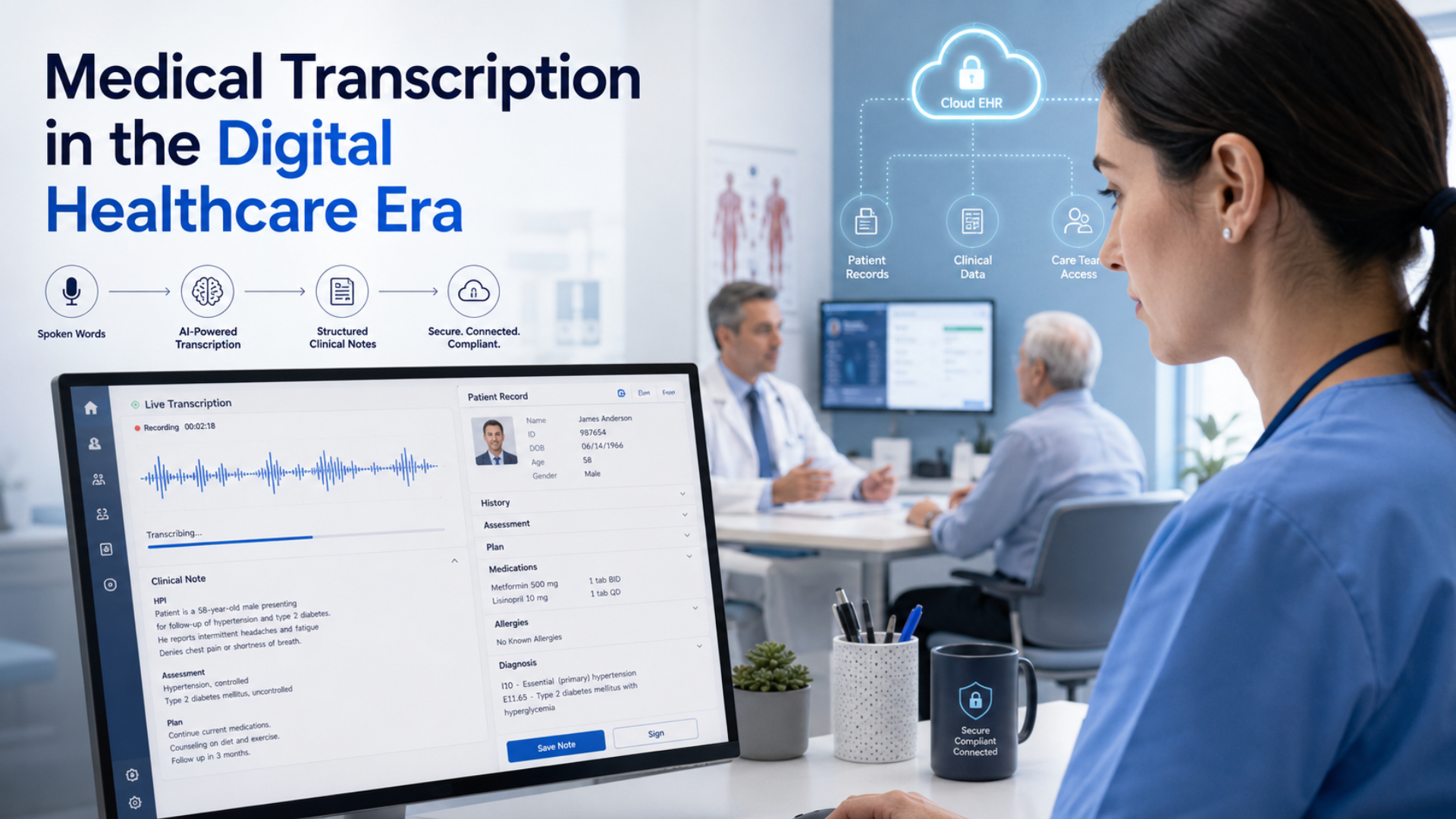
Medical transcription has evolved significantly with advances in digital healthcare technology. Traditional transcription workflows increasingly incorporate electronic health records, speech recognition, artificial intelligence, and automated documentation tools.
Modern transcription solutions can help convert spoken clinical information into structured digital text more efficiently. However, technology does not eliminate the importance of accuracy and human oversight. Medical terminology, context, accents, background noise, and complex clinical language can create challenges that require careful review.
The most effective approach often combines technology with appropriate quality-control processes to produce dependable documentation.
What Makes Medical Transcription Effective?
An effective transcription process should prioritize accuracy, confidentiality, consistency, and timely delivery. Transcription professionals and technology should be capable of handling complex medical terminology while preserving the intended meaning of clinical information.
Healthcare organizations should also consider data security and privacy when selecting transcription services or software. Appropriate access controls, secure systems, and compliance practices are essential when handling sensitive patient information.
The Future of Medical Transcription
The future of medical transcription is likely to involve greater integration between artificial intelligence, speech recognition, electronic health records, and clinical documentation platforms. Automated tools may increasingly assist with capturing and organizing information, while professionals continue to provide oversight where accuracy and clinical context matter most.
Rather than simply disappearing, medical transcription is evolving into a broader digital documentation process. Its core purpose remains the same: helping healthcare organizations turn clinical conversations and information into accurate, accessible, and useful records.
You can also watch: ***[Everyone is working, but the system is not connected](https://youtube.com/shorts/Ul_7E1sMpuI?si=OKm8Co1e-aeUwiJ3)***.
Summary
***[Medical transcription](https://medcore.software/blog/what-is-medical-transcription/)*** is important because it supports accurate documentation, improves communication, saves clinicians time, maintains complete patient records, and contributes to efficient healthcare operations. It can also support clinical decision-making, billing workflows, compliance, and record management.
As healthcare continues to become more digital, transcription processes are also changing. The combination of advanced technology, secure workflows, and human quality control can help healthcare organizations create reliable documentation while allowing medical professionals to focus more attention on patient care.
FAQs:
1. Why is medical transcription important in healthcare?
Medical transcription helps create accurate and organized patient records, supporting better communication, clinical decision-making, and efficient healthcare workflows.
2. What is the main purpose of medical transcription?
The main purpose is to convert dictated or recorded clinical information into accurate written documentation that can be stored and accessed as part of a patient’s medical record.
3. How does medical transcription improve patient care?
Accurate documentation gives healthcare professionals access to important patient information, helping them understand medical history, diagnoses, treatments, and follow-up requirements.
4. Does medical transcription save doctors time?
Yes. It can reduce the time healthcare professionals spend manually documenting patient encounters, allowing them to focus more on patients and clinical responsibilities.